An AI workforce that runs your operations end to end.
This is the system I run my own business on. You teach the AI a job once, it does that job for you from then on, and nothing goes out until you say yes.
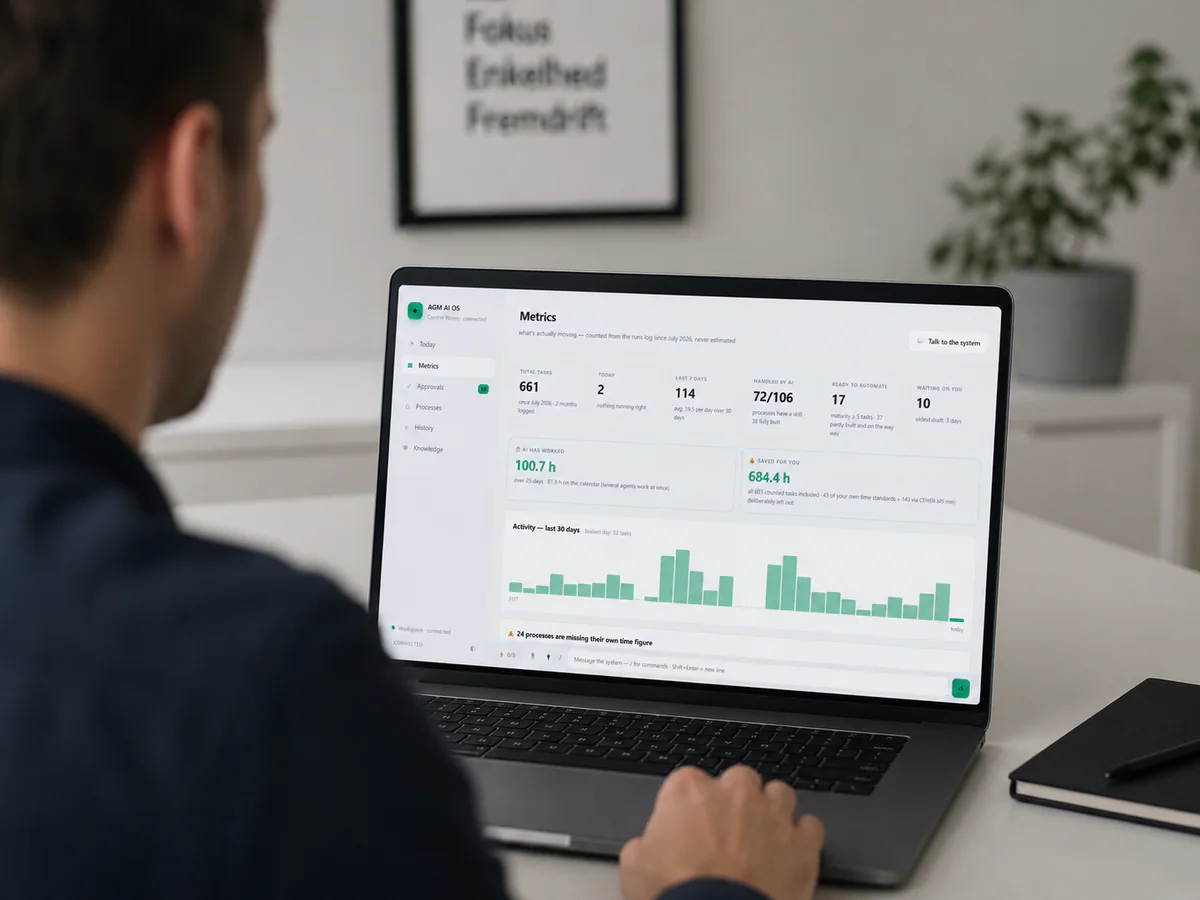
An AI operating system for the work your business repeats
The company where the owner still does the operational work himself, or where one or two people carry all of it, and where the same jobs come back every week.
AGM AI OS is an operating system for the operational side of a company. It installs on your own computer, you teach it the jobs you do again and again, and it does them from then on. It ships with the rules it works under, one short document you read before you run anything.
The work it takes is the work that comes back. The newsletter. The follow-up on unpaid invoices. The marketing that has to go out whether or not you had time this week. The admin that eats a morning. It does the job, writes down what it did, and puts the result in one place for you to go through once a day.
You never sit and write prompts. You explain a job once, the way you would explain it to somebody starting on Monday, and that explanation becomes the description it works from.
It runs on your own machine
The system, your files and the log sit on your own computer.
It works with the AI you choose
You choose the models and the agent harness. Both can be open-source and run locally on your own hardware.
It stops where you tell it to
Every job is sorted into one of three classes before it runs: it may do this alone, it must wait for you, or only you may act.
Putting AI into daily operations runs into the same two questions in every European company. Where does the data go, and who is accountable if the machine gets it wrong.
Your work stays on your machine, so the first question is answered by where the software lives rather than by a promise. You choose the provider, the models and the agent harness. AGM AI OS is designed with the EU AI Act in mind: a person approves anything that reaches a customer, so the answer to the second question is you, by design, on every run.
You pay for the system once. There is no monthly fee and no price per employee, which is the other thing that stops a small European company from putting AI to work properly.
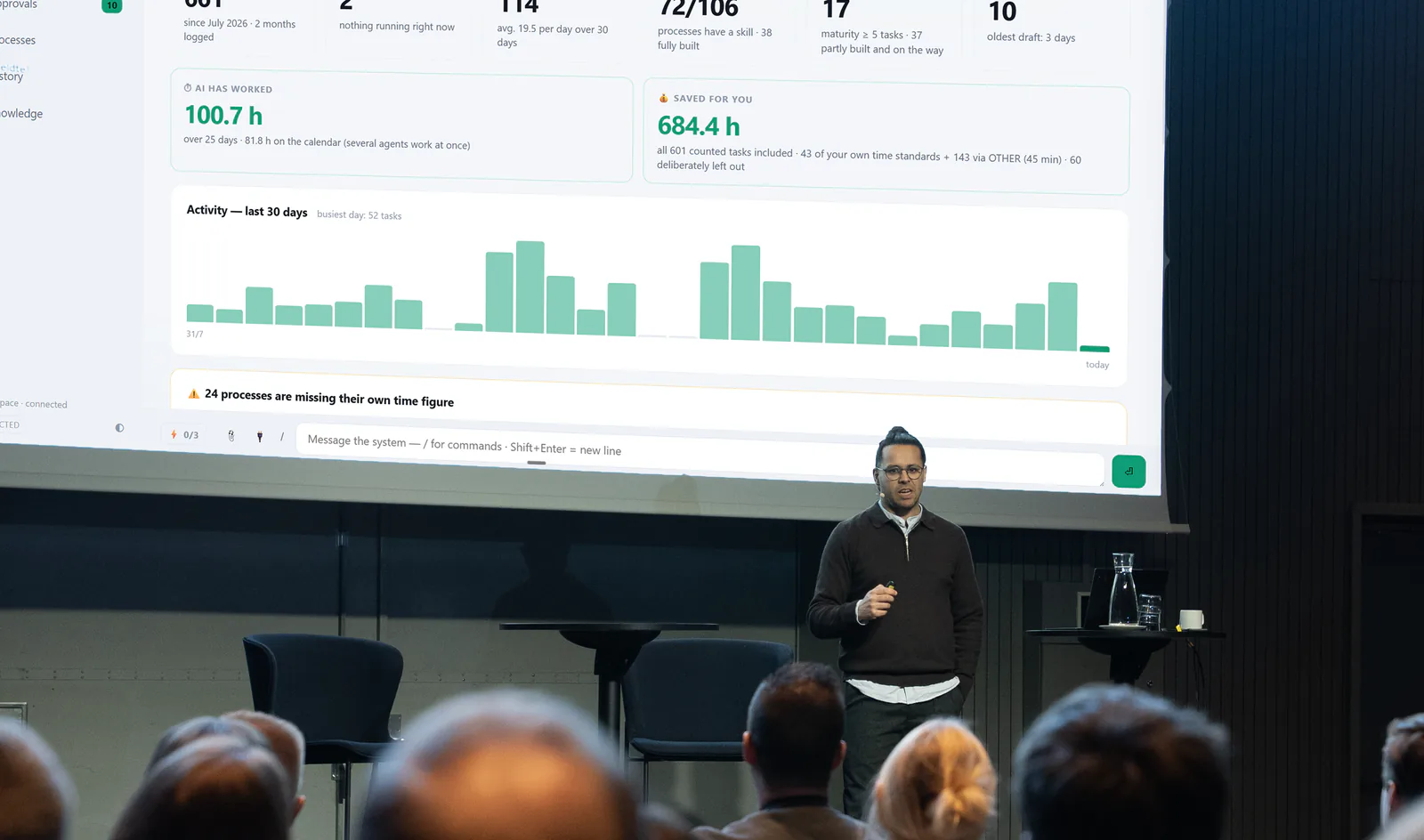
I created the system because I needed it myself
My name is Julian Bent Singh, and I run one of Denmark's most successful AI education and conference companies. I built this system for myself, because I was tired of starting from nothing in an agent chat window every morning.
The other reason was sharper. I already had AI running in several places, but it sat scattered across separate tools. I wanted one hub that tied it together, so I could put AI to work across the whole company from one place and let it take the operational jobs.
Now it runs my marketing, my finance, my sales, my admin and a good deal more of the day-to-day. That is how those jobs get done here, and every run sits in a log I cannot go back and tidy.
The gap between those first two numbers is the whole point. Each job I teach it stays taught, so the week that just ended did more work than the first month did.
The hours are an estimate from my own logged minute counts per run. Each figure is what that job would have taken me by hand, with several jobs running at once.
You decide how much it is allowed to do without you
Nothing here runs on its own because a model felt like it. Every job is one you wrote down, every run leaves a line in a log, and how much rope a job gets is yours to set. Nothing happens overnight unless you have said it should.
It fits the way you already work
You connect AGM AI OS to the tools, software and platforms you already use. The system is designed around your existing workflows, not to force you into new processes. Connect through an API or MCP, use the plugins, connectors or integrations available in your agent harness, or let it work through the browser when a platform offers no programmatic access. Computer use and browser use capabilities are included.
This is a dial, not a track. A job can stay on the second step for the rest of its life, waiting for your yes every single time, and plenty of mine do. My own advice is to leave it there until you are genuinely bored of approving it.
It cannot climb on its own either. Moving a job up is an edit you make in the list yourself. All the system does is tell you when a job has met the bar.
Five runs you started and watched, each one in the log. Long enough for the awkward cases to show up, and whatever went wrong in those five has to be written into the job description first.
Ten drafts in a row you approved without changing a word. The log counts approved-as-it-stood and approved-after-an-edit separately, so the streak is counted, not remembered.
One serious mistake and the job is back to manual until the mistake is written into its description. There is also a ceiling: anything that sends, publishes or moves money never reaches the last step.
One row per job: what it is, what starts it, how risky it is, how many times it has run. Not in the table means it does not exist and cannot be run. A run does only the job it was started for; anything else it notices becomes a suggestion.
A folder. Anything meant for someone outside your company waits here as a draft. Five to fifteen minutes a day: approve it, change it and approve it, or say no in one line. Approving and sending are two separate steps.
One line per run, one file per month: what ran, when, and what came of it. Failed runs too, by rule. This is where the counting happens, so the numbers above are counted and never assumed.
Every Friday it reads back the month of log lines, the drafts you said no to, and the difference between what it wrote and what you actually sent. Those edits are the sharpest signal it has.
It comes back with one document: what failed, what to change as the exact line to change, and what has earned more rope or less. It changes almost nothing itself. The report waits in the queue like any other draft.
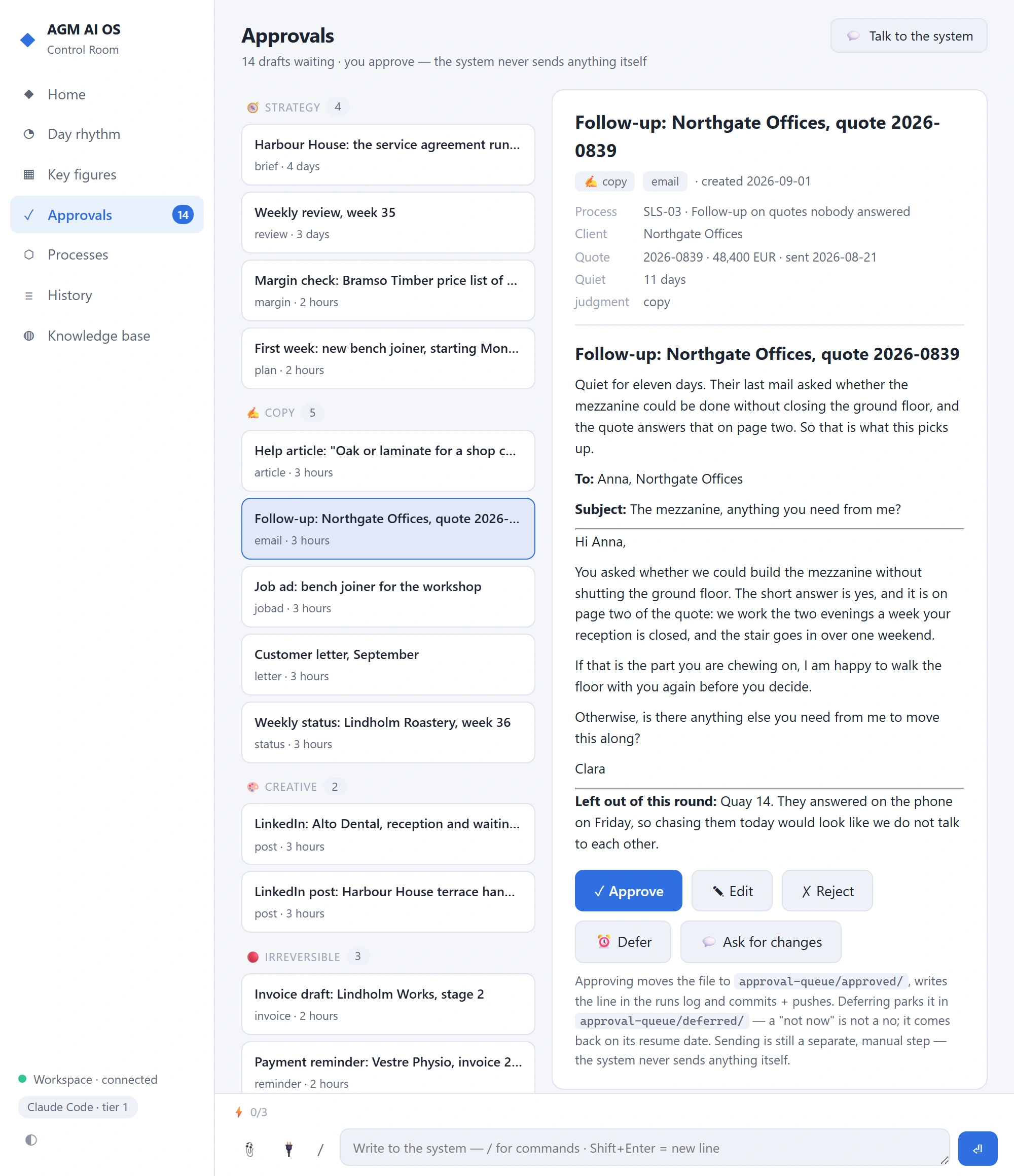
Fourteen drafts, sorted by the judgment each needs. One coffee to get through them.
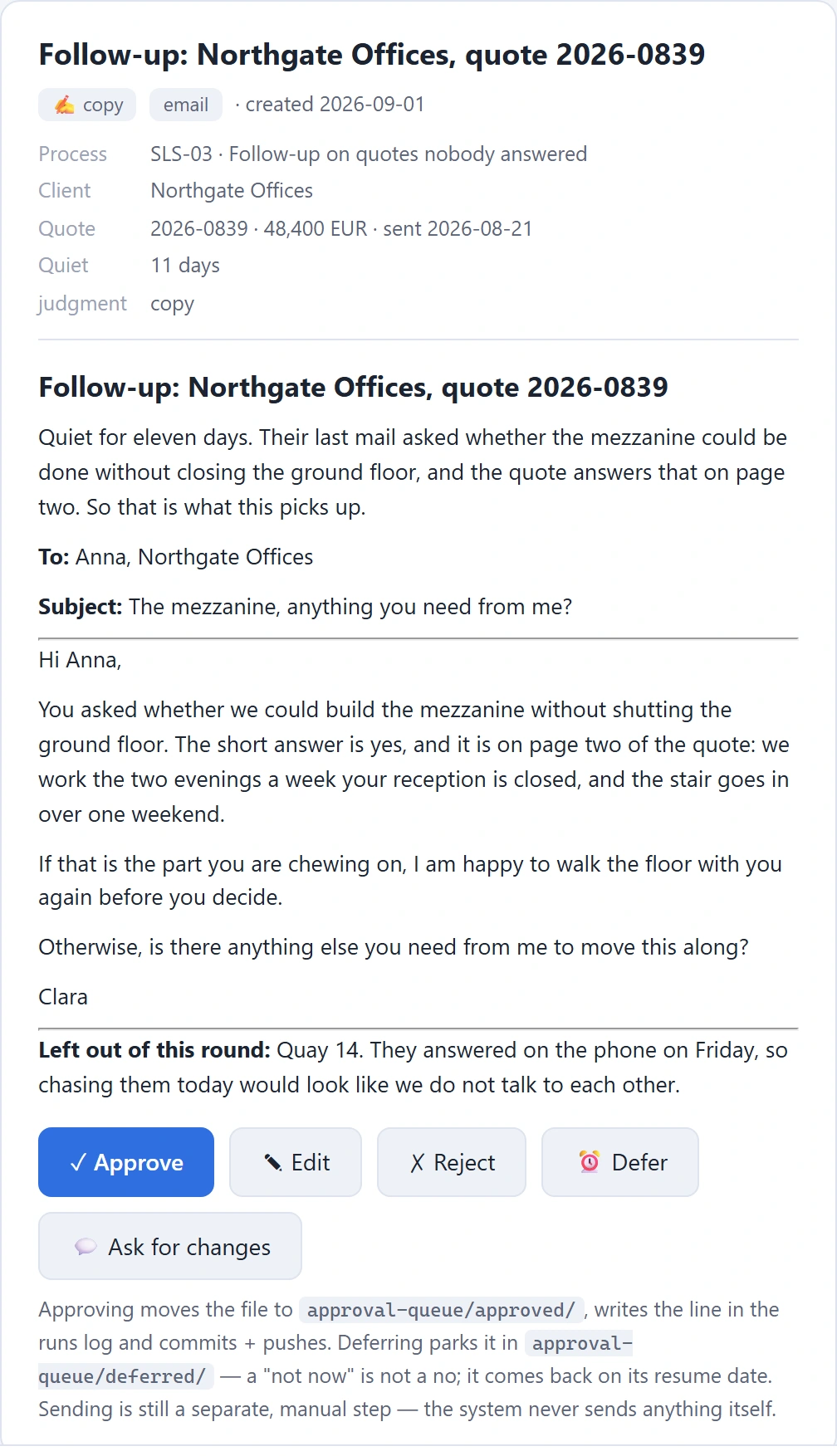
You read this, not a summary of it.
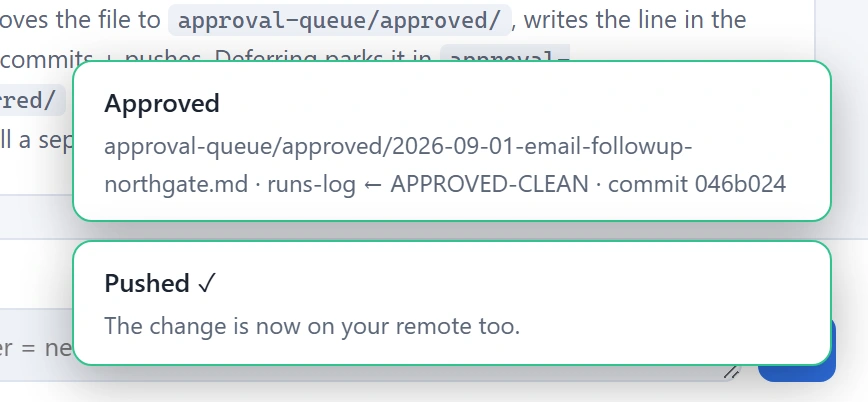
One click. The file moves, the run is logged, and the commit is real. You can look it up.
You explain it once, the way you would to a new colleague
You do not need to know anything about AI, and you do not set anything up. It interviews you for about half an hour and builds itself around your work, your rules and your way of saying things.
Pick something you do every week and talk your way through it, the way you would show a new colleague on their first day. You use your own words and your own language, and there is nothing to install or fill in first.
It writes down how you did it, in plain language you can read back and correct on the spot. What it wrote is the job description it works from afterwards.
You start the first five runs yourself, so you watch it get the job right before it runs alone. Whatever it makes after that still waits for your yes.
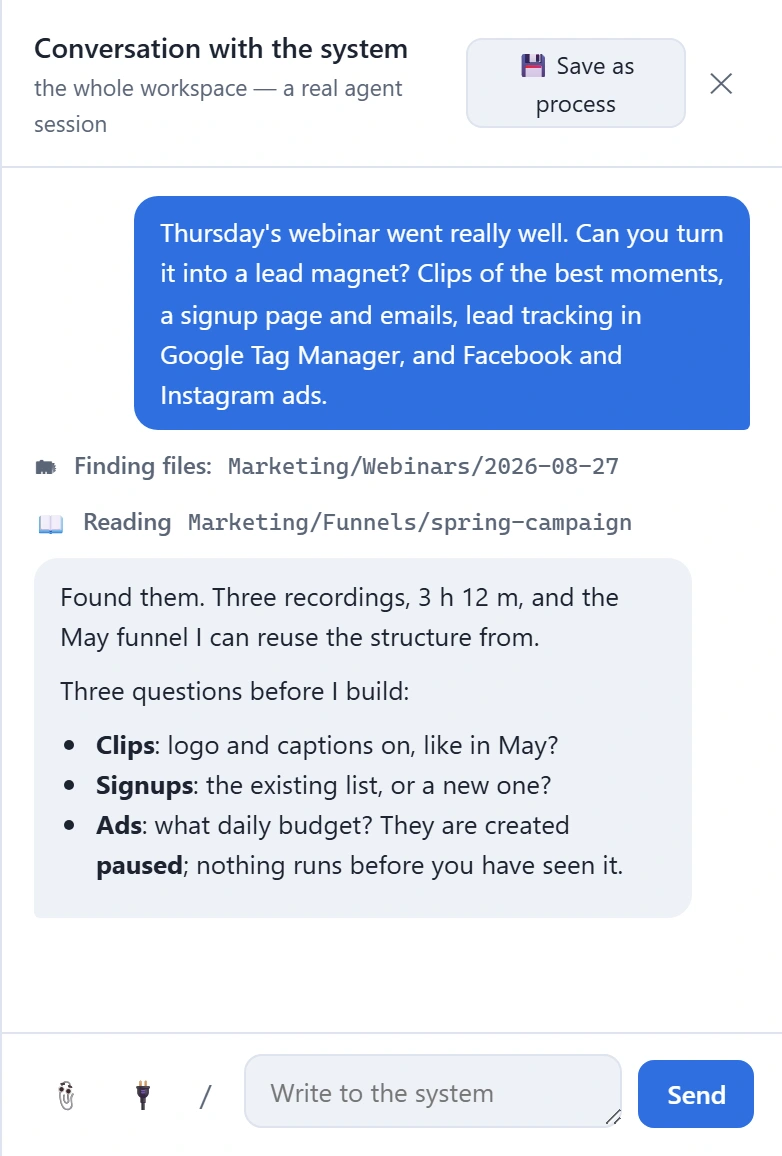
No prompt. You are just asking for it.
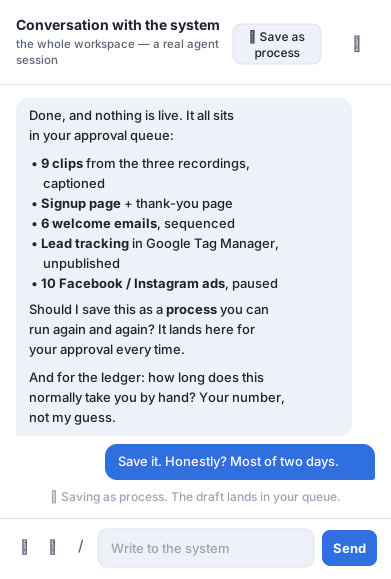
It asks to save the job as a process, and it asks what the job costs you by hand. Your number, not its guess.
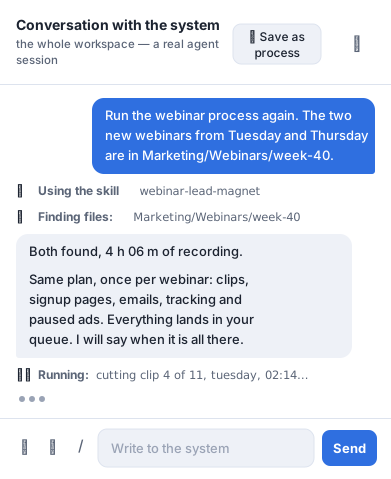
You start the first five yourself and watch it get them right.
And I show you all of it on video
Video guides come with the licence. I show you how to install the system and how to set it up so that it is tailored to your own company. I walk you through connecting it to your tools, your software, your platforms and the other systems you work in. And I show you how to teach it to carry out your own jobs, with several step-by-step examples.
Three trays. What the AI has made waits in the first one, and you move it to the second to say yes or the third to say no.
Underneath, these are ordinary folders on your own computer. You can open them the way you open any folder, though most days you will not need to.
On your machine, on the model you choose, in the language you speak
AGM AI OS never speaks to a model itself. It is folders, written rules and a log on your own computer, and the agent you already use does the talking. So where your work gets processed is settled by which agent you point it at, and that is your decision rather than mine.
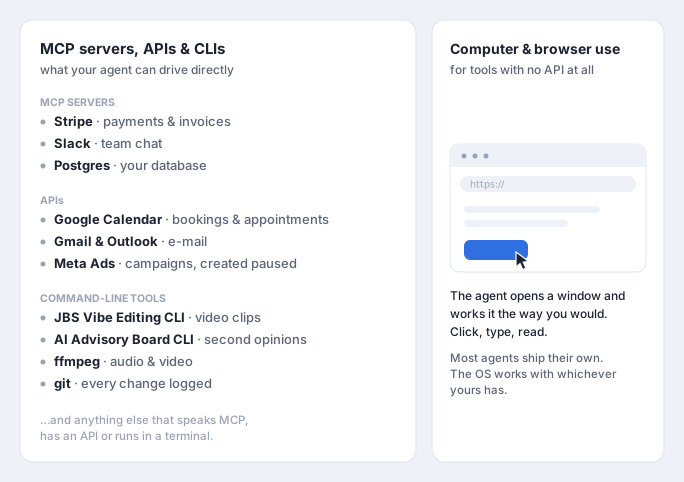
MCP servers, APIs and command-line tools. For everything without them, the agent uses the browser and screen the way you would. Whichever agent you run.
The installer looks for these by name. If you have none of them it still works: any agent that can read a markdown file and open a folder will do, and it tells you so rather than stopping.
- Claude Code
- OpenCode
A guard sits in front of the action itself and refuses it before it happens. On Claude Code that guard is a hook, on OpenCode a plugin. The refusal is written into the log like any other run.
- Codex CLI
- Gemini CLI
- Cursor CLI
- GitHub Copilot CLI
- Hermes Agent
- pi coding agent
- Grok Build
- Google Antigravity CLI
- Any other agent that reads markdown
The constitution governs these too, as rules the agent is told to follow rather than a lock it cannot pass. Same rules, weaker enforcement. I would rather you knew that before you paid than after.
Your agent decides which model does the thinking, and the model decides which country your work is processed in. Point your agent at a European provider and the whole thing runs inside the EU. Point it at a model on hardware standing in your own building and your work never goes online at all.
Which models you can choose from is your agent's business rather than mine. Some let you point them at any endpoint you like, in Europe or on your own hardware. Others only ever talk to the company that made them. That is worth settling before you install, because it is the choice that decides where your work ends up.
Nothing in AGM AI OS assumes an American provider and no part of it requires one. There is no integration to buy and no list of approved suppliers, because the system is files on your own machine and does not care where the model lives. The one thing that ever leaves is your licence key, when it is checked.
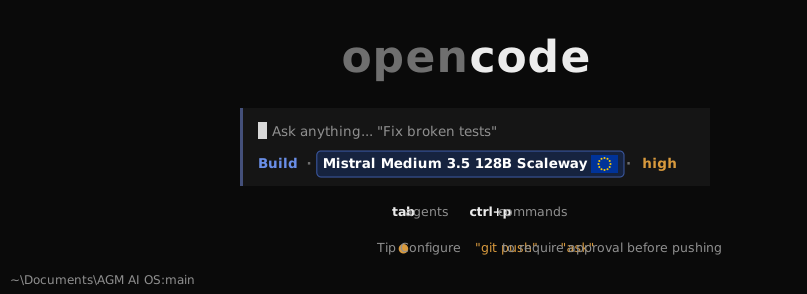
Same system, different country. Nothing else changes.
The first thing it asks, before anything else, is which language your system should run in: English, German, French, Italian, Spanish or Danish. Pick a number, or simply answer in your own language.
Everything follows from that answer. The interview, the rules document, the folder names, the job descriptions it writes down for you and the drafts waiting in your queue are all in the language you chose. You never work in English and translate afterwards.
English and Danish are checked by a person. The other four are translated by the AI itself, and the system tells you so once, in plain words, instead of leaving you to discover it.
Look it all up before you pay
I know how it looks to be asked for 1,275 EUR by a website you met ten minutes ago. So everything you would need to check me is on this page rather than scattered around.
I have done this work in public under my own name since 2017. None of the lines below take more than five minutes to verify.
Click the box to select the prompt, then paste it into ChatGPT, Claude or whichever AI tool you use.
Who is Julian Bent Singh?These sit here rather than in small print at the bottom, because you would want them before paying a stranger. The name on your card statement should also match the name you read here.
- Legal name
- Tabtimize ApS (AI Growth Minds is a brand of Tabtimize ApS)
- Company number
- Danish company no. 38975579, which you can look up at cvr.dk
- Registered in
- Denmark
- Responsible
- Julian Bent Singh
- How to reach me
- support@agm-ai-os.com
- Payment
- Stripe
- On your card statement
- Tabtimize ApS
The system runs on your own computer and your files stay with you. I cannot see them. Your licence key is the only thing the product sends me, once when you install and again when it checks the licence.
Whatever your AI provider sees is between you and them, which is part of why you pick the provider rather than me.
AGM AI OS is sold only to businesses. The complete B2B Terms of Service and the AGM AI OS privacy policy are on this site, in all six languages.